Packaging resource
Corrugated vs. cardboard: what’s the difference?
People use the words “corrugated” and “cardboard” interchangeably, but they are different materials with different capabilities. If you are sourcing packaging for shipping, fulfillment, or retail, understanding the difference will help you specify the right product and avoid costly mistakes.
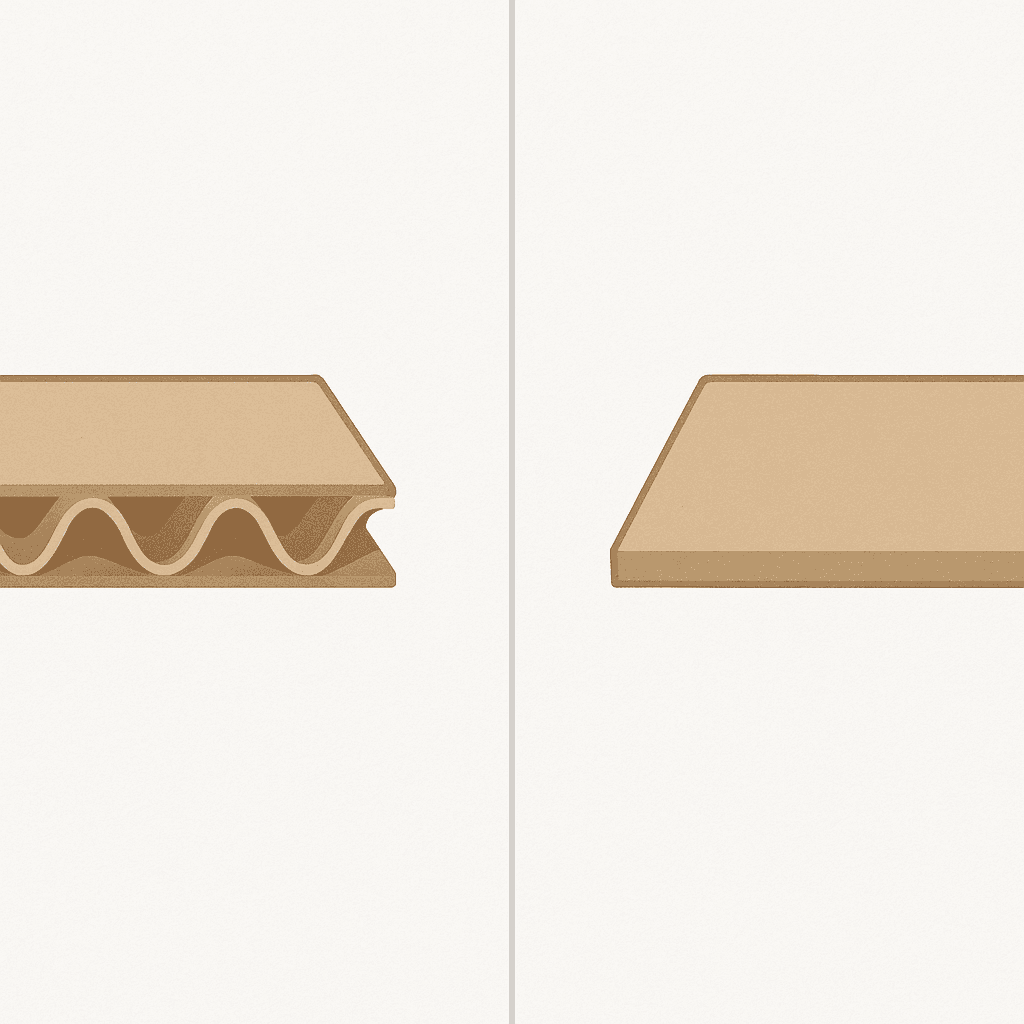
The short answer
Corrugated boardis a multi-layered material made from flat linerboard sheets bonded to a wavy inner layer called fluting. That fluted medium is what gives corrugated boxes their strength, cushioning, and stacking ability. When people talk about “shipping boxes,” they almost always mean corrugated.
Cardboard (more accurately called paperboard or chipboard) is a single layer of thick paper stock. It is the material used in cereal boxes, shoe boxes, and similar retail packaging. It has no internal fluting, limited stacking strength, and is not designed for shipping protection.
The confusion comes from everyday language most people call any brown box “cardboard.” But in the packaging industry, the distinction is important because it determines what a box can actually do.
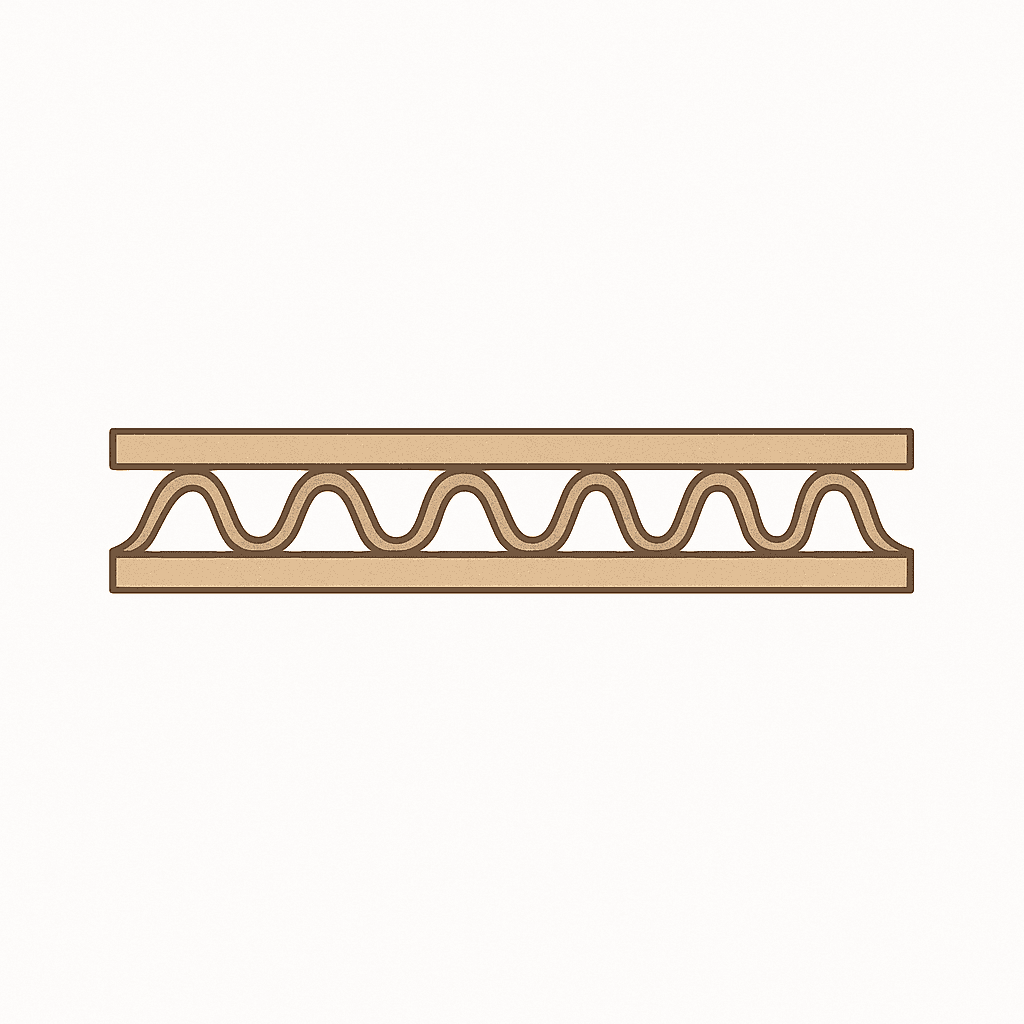
Single-wall corrugated cross-section: two flat linerboard sheets bonded to a fluted medium.
How corrugated board is constructed
Corrugated board starts at a corrugator a large machine that heats, shapes, and bonds the components together. The fluted medium is formed into a wave pattern and then glued between two flat linerboard sheets using starch-based adhesive.
The result is a composite material that is lightweight but strong. The arches in the fluting resist pressure from the top (stacking) and absorb impact from the sides (cushioning). Different flute profiles, A, B, C, E, and F, offer different balances of thickness, crush resistance, and print surface quality.
For heavier loads, double-wall and triple-wall constructions add extra flute layers for greater strength.
How they compare
Here is a practical comparison across the factors that matter most when choosing packaging materials.
Structure
Corrugated
Multiple layers flat linerboard bonded to a fluted (wavy) medium. Available in single-wall, double-wall, and triple-wall constructions.
Cardboard / Paperboard
Single layer of thick paper stock, sometimes called paperboard or chipboard. No internal fluting.
Strength
Corrugated
Designed for stacking, shipping, and protecting products in transit. ECT ratings from 23 to 71+ lbs per inch of edge crush strength.
Cardboard / Paperboard
Suitable for lightweight applications. Limited crush resistance and stacking strength.
Typical uses
Corrugated
Shipping boxes, master cartons, pallet displays, industrial containers, e-commerce mailers, produce and food packaging.
Cardboard / Paperboard
Cereal boxes, shoe boxes, backing boards, greeting cards, cosmetic packaging, food cartons.
Weight capacity
Corrugated
Can handle products from a few ounces to hundreds of pounds depending on wall construction and flute type.
Cardboard / Paperboard
Generally limited to lightweight consumer goods typically under 5–10 lbs.
Cost
Corrugated
Higher per unit due to multi-layer construction and manufacturing complexity. Economical at scale for shipping protection.
Cardboard / Paperboard
Lower per unit. Cost-effective for retail-facing consumer packaging where shipping protection is handled separately.
Printing
Corrugated
Flexographic printing is standard. Litho-lamination or digital printing available for higher-end graphics.
Cardboard / Paperboard
Offset lithography is standard. Higher-quality print resolution and finish options for retail shelf appeal.
When to use corrugated vs. cardboard
Use corrugated when the box needs to protect a product during shipping, stack on a pallet, survive carrier handling, or support any meaningful weight. This includes e-commerce shipments, wholesale cases, industrial parts, food packaging, and anything moving through a supply chain.
Use cardboard (paperboard) when the packaging is primarily for presentation or point-of-sale cereal boxes, cosmetic cartons, pharma folding cartons, and similar lightweight retail packaging where the outer shipping container provides the actual protection.
Many products use both: a paperboard inner carton for branding and shelf appeal, packed inside a corrugated outer shipper for transit protection.
A note on terminology
When you request a quote from a supplier, use the word “corrugated” if you need a shipping container. If a supplier quotes you “cardboard boxes,” confirm whether they mean corrugated board or paperboard the performance difference is significant.
Find the right supplier
Looking for corrugated box suppliers?
Browse the directory to compare manufacturers and distributors by capability, location, and box type. Every listing is specific to corrugated packaging.